Knowledge
Patient Feedback: Definition, Purpose and Benefits (With Free Template)

TRUSTED BY BEST-IN-CLASS BRANDS



Patient feedback plays a crucial role in the healthcare industry. Don’t believe me? What if I told you that for every unhappy patient who complains, dozens more leave without a word and never return?
Half of the feedback does not even reach your ears, let alone get resolved. And we don’t want that to keep happening, do we? For this, it is important to understand patient feedback, why it is so vital, how to collect it, and its benefits.
(I have squeezed in a free sample template since all this can be better understood with an example. So, feel free to try it out)
Off we go!!
What is Patient Feedback?
Patient feedback deals with the opinions, thoughts, and preferences of people who have received healthcare services. The primary goal is to get real-time patient responses so that healthcare professionals can note the expectations and areas for improvement to enhance the patient experience.
Feedback includes surveys, verbal feedback, or even comments on third-party platforms. However, surveys are the preferred mode for healthcare practitioners.
You need to identify if your practices are falling short. Are your patients frustrated? Do they feel rushed during consultations? To do this, you must send a Patient Feedback Survey.
Here’s a free template made with SurveySparow that you can use. You can share the survey via any communication channel or embed it in an email. To track the journey consistently, try to do it within a few days of the visit.
Feel free to customize this template if you like it. If you need help, I have added an easy guide.
Patient Satisfaction Survey Template
Use This TemplateLet’s move on to…
Importance of Patient Feedback
Quality of care is paramount. But, each individual will have different preferences and opinions. Again, it is impossible to consider every feedback. Still, you can reach a consensus by analyzing the trends and patterns. It will also help you personalize your services.
Let’s look at the reasons.
- Quality Improvement: Tracking journeys can improve your services. This includes interactions with service providers and the other facilities provided at the institution.
- Adherence to Regulations: Healthcare institutions must collect patient feedback for security and regulatory compliance. In the US, you must implement the Hospital Consumer Assessment of Healthcare Providers and Systems (HCAHPS) survey.
- Reduced Cost: Regular feedback will help you monitor quality. This will reduce the potential cost you might incur in malpractice cases brought by professionals or dissatisfied customers.
- Personalized Care: Moreover, by treating the patient’s needs and requirements as your core, you can provide quality treatment. This will enhance satisfaction and build a How are sense of trust in them.
How to Collect Patient Feedback?
Are you someone who feels feedback collection is a long and tedious task? It is pretty normal to feel lost in the process. Why don’t we take a look at the methods?
Surveys are the primary method used to collect feedback in the healthcare industry, so I’ll focus more on that than the others.
Feedback Surveys
Surveys are the preferred mode because they are cost-effective and easy to use. Their multifaceted nature is also a plus. You can take a survey electronically, on paper, or in person.
But imagine reaching out to the millions of patients and talking to them. Further, imagine the paperwork that you need to handle. Hence, in the healthcare industry, online surveys work better than others.
They help collect customers’ opinions, thoughts, ideas, and suggestions. Having the backup of patient experience tools is crucial in such cases. SurveySparrow can streamline the process. With the platform, you can create HIPAA-compliant surveys and forms, share them via multiple platforms, and collect and visualize them on an executive dashboard.
Plus, you can dive deep into the data with sentiment analysis and AI-driven text analytics. The platform also offers a recurring survey feature to help you automate your workflow. Turn on notifications, and never miss out on feedback!
Take it for a free spin and see if you like it.
Now, surveys are not the only way.
Interviews
An in-depth interview with the patients will reveal the pain points. These can be conducted face-to-face or via a phone call. Open-ended questions will fetch honest responses, leading to a better understanding of the situation. But again, there is an issue regarding time and comfort.
Firstly, the database of patients in the institution might be massive. Interviewing each one is not feasible. Similarly, when there is direct contact with the officials, the patients might shy away from being genuine if there is negative feedback.
Online Review Platforms
If you are listed on third-party platforms, the reviews will give you a detailed view of patient sentiments. Most of us share our views on separate platforms since it is a slightly less official mode of collecting feedback. Moreover, these responses can be trusted as they are not the direct outcome of a nudge from you or any officials.
Next, why don’t we examine a few types of feedback surveys?
Examples of Patient Feedback
Feedback is not restricted to the treatment provided but extends to the hospital facilities and their interactions with all the service providers. Here are a few common types of feedback that are usually collected. Oh, and I have added sample templates so you can use them directly if needed.
Let’s start with the most common one…
Hospital Feedback
The aim is to gather insights into patients’ overall experience in a medical institution. This includes opinions on services, comparisons to previous experiences, and the appointment process. A hospital feedback form is sent to the patients to address their needs and suggestions before the next visit.
Feedback on Doctors
Doctor Feedback surveys help assess specific interactions with doctors. The responses will provide insights into the efficiency and effectiveness of the treatment. Here, aspects like communication skills, wait times, and overall experience are measured.
You can also understand the effectiveness of specific treatments by looking into the symptom relief and recovery progress.
Feedback about other Service Providers
This includes all opinions about all the individuals a patient had to interact with other than a doctor. This could consist of those at the front desk, cleaning department, pharmacist, and nurses.
You can roll out a physical therapy evaluation form to get feedback on the effectiveness of the treatment. If you look at hospital interaction, nurses constantly contact the patients. In such cases, sending a nurse feedback form will also be effective.
Analyzing and Acting on Patient Feedback
Once you have the dataset, your next goal is to break down the information. You need to first…
Organize the Data
The first step is to categorize the data by theme, department, or specific touchpoint. If there is quantitative data, take the average and branch it down. Once that is done, it is time to find patterns and trends. Now, not every feedback has the same weight. Some might be lighter, while others might need immediate attention.
For example, one patient complained of acute pain in their leg but had to wait more than three hours for an appointment with the doctor. At the same time, if someone comments on the traffic near the hospital that delayed their arrival, which one do you think must be prioritized? Of course, each has value, but prompt action at appropriate instances will help enhance the overall patient experience.
Immediately after that…
Set SMART Goals
SMART expands to Specific, Measurable, Achievable, Relevant, and Time-bound goals, and they define what you want to achieve, how you want to, what you will measure, and decide a timeframe for implementation.
Once that’s done, assign the priority work to respective teams and establish guidelines and a clear timeframe for achieving it.
Timely Communication
Your plans should be communicated to your patients. You should not leave them wondering what happened to their feedback. Let them know what you plan to do and your targets, and appreciate their participation. Above all, transparency creates a sense of trust.
Attentively Monitor
Once you implement the ideas, track the advancements. When you ask for feedback, make sure the same negative feedback is not repeated.
Again, feedback is a never-ending process. Keep seeking feedback and making improvements so you can grow consistently and modestly.
Best Practices for Collecting Patient Feedback
There are a few things you should consider while collecting responses. Make sure you always…
- Ask questions specific to their experience. Don’t beat around the bush.
- Give them the space to express their opinions and thoughts. You must include open-ended questions throughout the survey.
- Also, while giving options, try to use a neutral tone. Options with an accusatory tone might lead to survey abandonment.
- Regularly document the experience at regular intervals. Just one feedback will not give you a comprehensive idea.
How to Use SurveySparrow for Product Feedback
Using SuvryeSparrow does not require technical skills. The drag-and-drop builder makes survey and from creation as simple as pie! Plus, the AI survey builder can make your surveys with just a hit a prompt.
Here’s how you do it…
Step 1: Log in
Log in to your SurveySparrow account. Don’t have one? Fear not! There’s no better time than now to create one!
You can get started with a 14-day free trial.

Once that’s done…
Step 2: Create
Now, you have two options. If you want to craft a survey from scratch, click (+) New Survey.
To customize a pre-built survey, hit the Browse Classic Surveys and search for the template of your choice. Let’s say you chose the patient satisfaction survey template attached above.
Step 3: Customize
This is the fun part! You can edit the pre-filled survey to your heart’s content. With the Wing Feature, you can edit the questions to your heart’s content. Remove the ones that don’t fit the bill or add new ones that you find useful.
Check this out for a second…
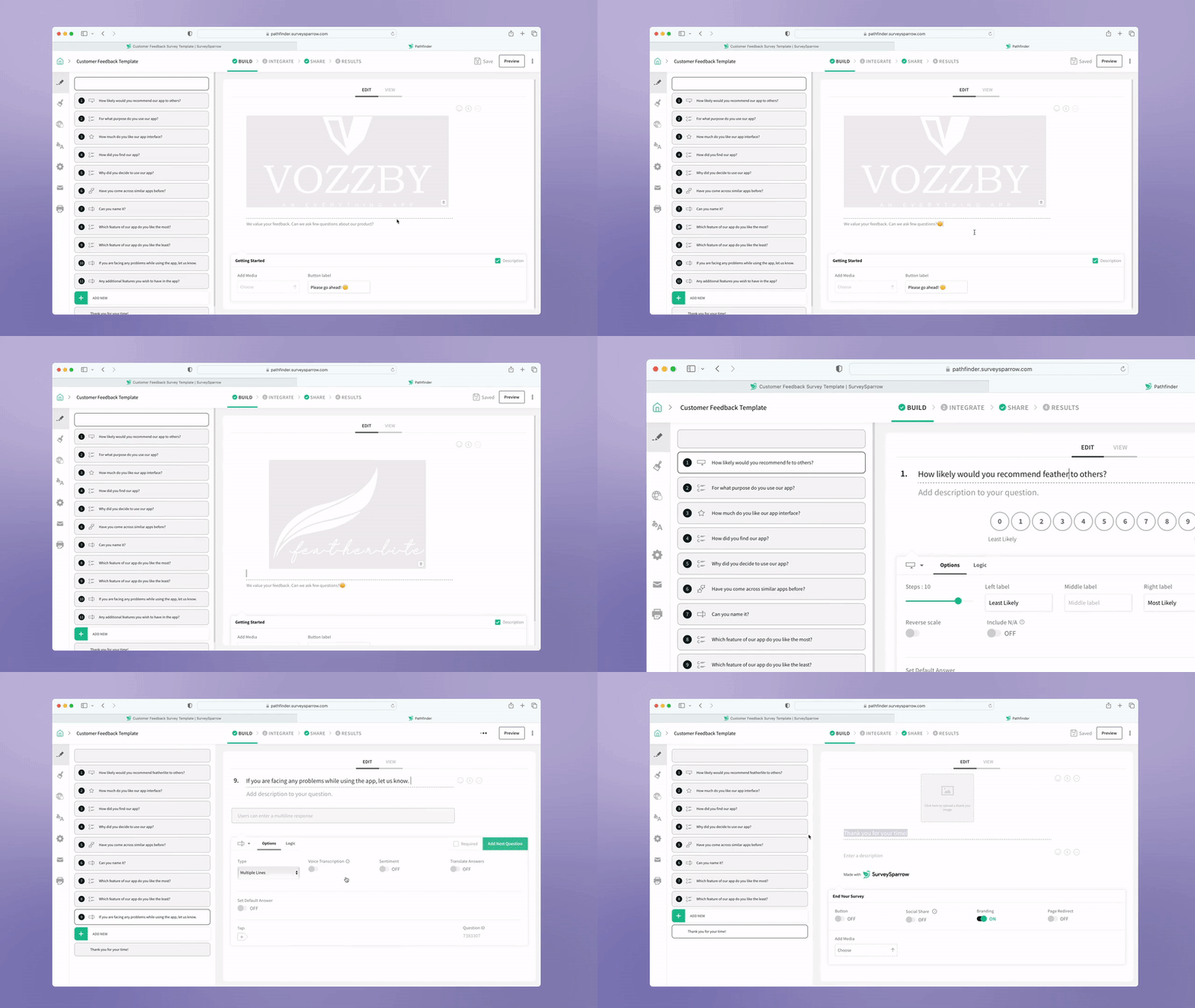
It’s that simple.
Now…
Step 4: Integrate and Share
Connect with an array of third-party integrations to streamline your workflow. Popular tools include Zapier, Mailchimp, HubSpot, and Salesforce.
Once that’s sorted, your Patient Feedback Survey is ready!
You can share it via social media, SMS, or WhatsApp or embed it in an email.
Next, it is time to…
Step 5: Analyze
Use advanced analytics tools such as sentiment analysis to break down the responses. The AI-driven Text Analytics tool CogniVue, will help you conduct a key driver analysis and highlight your hidden strengths and weaknesses.
Oh, you need not do all this with your pen and paper! The Executive Dashboard allows you to visualize each aspect and gain detailed insights.
You get all this in one platform! No more jumping around from one tool to the other. Well, isn’t that just useful?
Why don’t you come on board and get a feel of the platform before you invest?
Wrap Up!
Patient feedback cannot be taken for granted. By collecting, analyzing, and acting on feedback, you can provide care based on the patient’s needs and requirements. The aim is to enhance the overall patient experience. Note that there is no shortcut to this. It is a continuous and iterative process!
Survey Away!
FAQ
1. What are the different types of patient feedback?
A. This includes qualitative (patient satisfaction surveys, ratings, and scores), quantitative (Open-ended comments), indirect (online reviews), and real-time feedback (kiosks).
2. How can feedback be used to improve clinical outcomes?
A. Identify the areas that need detailed communication and patient education. Find out the barriers and make strategies. Once that’s done, take clear action to address them.
3. How can healthcare organizations close the loop on feedback?
A. Do not stop at collecting feedback. Let the patients know what actions are being taken based on their suggestions. Also, appreciate the time that they invested in you for providing feedback.